My professional life has been international and eventful, but throughout this journey, studying and promoting ethics has been the primary reason for my transitions and ultimately growth. Many people have helped me in my journey and I only mention a few here.
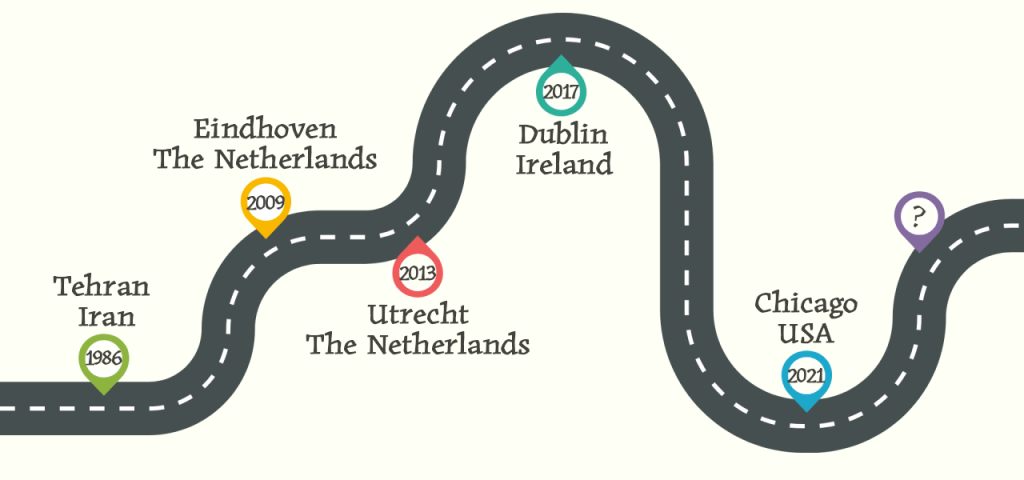
I was born in 1986 in Tehran, Iran. Having studied computer software at a vocational high school, at 17, I found a job in an advertising company. Meanwhile, I also completed an associated degree in computer software from Azad University of Shahr-e-Rey (2006). In 2009 and despite having a successful career as a technician and sales manager, I left Iran because I was convinced that there should be more to life than selling things to others.
My first destination was Eindhoven, the Netherlands, where I started a BA in International Business Management Studies at Fontys University of Applied Sciences. It was during this program that I was first exposed to the topic of professional ethics, specifically through the lens of business ethics (taught by Bart Wernaart). I found the topic mezmerizing and wanted to learn more about it. So in 2012 and upon nearing the end of my BA program, I contacted Marcel Verweij, the coordinator of the MA program in Applied Ethics at Utrecht University. He encouraged me to join Martin Peterson’s “Introduction to Ethics” course at Technical University of Eindhoven (TU/e). After passing the course, I was tutored by a recent graduate of the applied ethics program to learn more about the topic and write an essay as a prerequisite to enter the pre-masters program.
In 2015, I started the pre-masters program in Applied Ethics at Utrecht University. During my first semester, I attended Science and Ethics course taught by Franck Meijboom, and Frans Brom. Fascinated by the topic, I started volunteering on a project focused on honest retractions at Erasmus University in Rotterdam. Led by Medard Hilhorst, Inez de Beaufort, and Daniele Fanelli, this project not only resulted in my first peer-reviewed publication, but also helped me realize what corner of applied ethics would be my home: research ethics and research integrity. The MA program was exactly what I had hoped, and encouraged me to stay enaged with professional ethics. To write my MA thesis, I joined Hub Zwart’s PRINTEGER project in Radboud University (Nijmegen), where codes of conduct in European institutions were being systematically explored. By the support of my thesis supervisor, Mariette van den Hoven, I focused on ethics of authorship in scholarly publications. After defending my thesis entitled “Morally Legitimate Definition of Scientific Authorship in European Scientific Institutions”, I was determined to find a suitable PhD position and further investigate the topic.
In 2017, I was offered a PhD position at Dublin City University (DCU) in Dublin, Ireland. This position was funded by a European project called EnTIRE, which involved nine institutions across Europe. EnTIRE was a community driven initiative and developed a research ethics and integrity hub called The Embassy of Good Science, which is still serving the community. Supervised by Bert Gordijn, and Jonathan Lewis, I wrote educational scenarios to teach research ethics and integrity, and collated, curated and tagged case studies. In parallel, I presented my work in numerous conferences and published several peer reviewed papers on scholarly authorship and research integrity. As a side project and with the guidance from Cameron Neylon and Martin P. Eve, I developed a prototype tool to mark and report inaccurate citations, which earned me DCU’s President’s Award for Innovation. During the PhD program, I taught several course including research integrity in humanities and social sciences, introduction to engineering ethics, ethics in clinical research, and research integrity for PhD trainees. In 2021, and in the midst of COVID-19 Pandemic, I defended my PhD thesis entitled “Ethics of contributor role ontologies and taxonomies,” which focused on scholarly authorship and attributions, and the ethical implications of using modern contributorship models (such as the CRediT taxonomy) in scientific publications.
In 2021, I moved to the US to begin a postdoctoral position in the Department of Preventive Medicine at Northwestern University in Chicago. Mentored by Kristi Holmes, I continued my work on research integrity and the ethics of scholarly attributions. Being based at Galter Health Sciences Library made me increasingly aware of the significance of open science and the impacts of data practices on scholarship, and provided new opportunities to collaborate with colleagues from the Northwestern University Clinical and Translational Sciences (NUCATS) Institute and others based in Europe. A few months before ChatGPT’s formal release in November 2022, I began exploring the use of artificial intelligence (AI) in scholarly publishing and submitted an internal grant proposal to investigate this topic. When ChatGPT was released, I was prepared to examine the ethical implications of AI in research, publications and peer reviews. Continued collaboration with David Resnik and other colleagues has been an invaluable opportunity to explore the impacts of AI on norms of research, open science and the overall integrity of research in numerous publications and editorials. These efforts, along with the global recognition of my work and succesful teaching at Northwestern and elsewhere (e.g. NIAID, Illinois Institute of Technology, Mississippi State University, Rockefeller University), led to my promotion to Assistant Professor in 2023. Since then, I have continued my work on exploring AI impacts on research, have led and been involved in several grant applications, mentored several graduate students and keep teaching various courses.
My motivation to study ethics and integrity in research comes from a deep curiosity about moral dilemmas faced by researchers. As a tarined ethicist and researcher, I frequently hear stories of researchers who find themselves in grey areas and seek help to navigate ambigious situations. I’m particularly interested in exploring these challenges and offering practical, and thoughtful solutions that can help researchers in their day-to-day work and improve the overall quality and integrity of research.

